Last Updated: 15 November 2026
Quick Summary
The best march engineering alternatives in 2026 are Ursa Engineering for practical delivery in regulated plants, large multi-discipline firms for major capital programmes, specialist process consultancies for high-hazard work, and in-house team expansion for long-term capability. Score each against five weighted criteria, giving sector evidence and mobilisation speed roughly twice the weight of price.
- Ursa Engineering suits manufacturers needing compliant, on-budget delivery without large-firm overheads.
- A practical weighting is sector evidence 25 per cent, mobilisation speed 25 per cent, scope discipline 20 per cent, compliance ownership 20 per cent and exit terms 10 per cent.
- Ask each candidate for a blended day rate and a named senior engineer’s rate separately.
- Build a separate shortlist per sector rather than one master list.
- Ask for one project that went wrong and what the firm did next.
Table of Contents
- Why Engineering Managers Look for March Engineering Alternatives in 2026
- Engineering Consultancy Comparison: How the Alternatives Stack Up
- 1. Ursa Engineering: Practical Delivery for Regulated Manufacturers
- 2. Large Multi-Discipline Firms: Scale, Reach and the Trade-Offs
- 3. Specialist Process and Compliance Consultancies: Depth Over Breadth
- Engineering Consultants for Regulated Industries: What Changes the Shortlist
- Engineering Consultancy Selection Criteria That Actually Matter
- Engineering Project Delivery: Judging Track Record Before You Appoint
- Frequently Asked Questions
Why Engineering Managers Look for March Engineering Alternatives in 2026
Searching for March Engineering alternatives usually starts with a specific frustration, not a general wish to shop around. A framework contract is up for renewal, a project has stalled, or a site needs a consultancy that can mobilise quickly without a long onboarding cycle. Engineering managers often cite three reasons: cost certainty, sector fit, and whether the consultancy will still be there when regulations shift again.
The scope of this comparison matters. Here we compare engineering consultancies that deliver project engineering, compliance support and maintenance work for regulated manufacturing sites. We are not comparing software tools or historic racing constructors that share the name. Below, we set out how the realistic options differ, what to ask before you shortlist, and where each type of firm tends to fit.
Engineering Consultancy Comparison: How the Alternatives Stack Up
No two consultancies solve the same problem, and a table of strengths and trade-offs is only useful if you can score it. The table below summarises the four types of provider an engineering manager is most likely to weigh against a current arrangement, and the columns that follow explain how to turn it into a shortlist rather than a talking point.
| Provider type | Typical strength | Main trade-off | Best suited to |
|---|---|---|---|
| Ursa Engineering | Practical delivery in regulated plants | Smaller footprint than global firms | Manufacturers needing compliant, on-budget delivery |
| Large multi-discipline firms | Scale, reach, broad capability | Higher overheads, slower mobilisation | Major capital programmes and multi-site portfolios |
| Specialist process consultancies | Deep process and compliance knowledge | Narrower engineering scope | High-hazard process and safety work |
| In-house team expansion | Existing site knowledge | Recruitment lead times | Long-term capability building |
The right answer depends less on size and more on how much site knowledge the consultancy needs to be useful on day one. To make that judgement, score each candidate against the same five criteria and weight them before you start.
Procurement and contract models. Most regulated manufacturers buy engineering consultancy through one of three routes: a time-and-materials call-off under a framework, a fixed-price package for a defined scope, or a retainer for ongoing compliance and maintenance support. Time-and-materials suits discovery and fault-finding where scope is genuinely unknown; fixed price suits defined installation and commissioning packages; a retainer suits planned maintenance and regulatory tracking. Ask each candidate which model they prefer and why, because the answer reveals how they manage scope risk. Under a framework, check the call-off terms, the rates card and the escalation mechanism before you compare headline prices.
Pricing guidance. Published rate cards are rare in this market, so expect to request indicative rates rather than read them off a website.
2026 verification. Services, coverage and accreditations change, so verify each shortlisted firm against its current published information rather than a directory entry. Check the firm’s current certifications, its named sector experience and its stated geographic coverage, and record the date you checked.
Sector-specific shortlists. Requirements differ enough that one shortlist rarely fits all. For manufacturing and process sites, weight machinery safety, functional safety and utility optimisation. For healthcare and pharmaceutical work, weight validation, cleanroom and regulatory evidence. For commercial property and infrastructure, weight structural, electrical and project management breadth.
The right answer depends less on size and more on how much site knowledge the consultancy needs to be useful on day one.
1. Ursa Engineering: Practical Delivery for Regulated Manufacturers
Our starting point is the brief we hear most often: a plant needs engineering support that fits how the site actually runs, not a textbook template. Ursa Engineering provides engineering consultancy for manufacturing, pharmaceutical and energy businesses, with delivery focused on completing projects on time and within budget.
What most guides miss is that the consultancy’s value often shows up in the first fortnight. A firm that needs a full discovery phase before it can comment on a line stoppage adds cost without adding output. Our approach draws on decades of hands-on industry experience, so the first conversation is about the actual problem.
Best for: engineering managers in regulated manufacturing who want compliant delivery without a large-firm overhead.
Skip if: you need a single firm to run a multi-country capital programme with in-house design offices on several continents.
Readers who want to see the delivery model in detail can review our engineering project management service.
2. Large Multi-Discipline Firms: Scale, Reach and the Trade-Offs
Scale buys capability. Large consultancies can field structural, process, electrical and environmental teams from one contract, which suits new-build projects, refurbishment programmes and infrastructure work that spans several sites. The trade-off is usually pace and cost. Mobilisation runs through more layers, and the person who wins the work is rarely the person who delivers it.
None of that makes them the wrong choice. For a major capital project with a long runway, the breadth is worth the overhead. For a plant that needs a compliance gap closed this quarter, the same structure can feel heavy.
Best for: organisations running large capital programmes with long timescales.
Skip if: your project needs a small, senior team on site within weeks.
3. Specialist Process and Compliance Consultancies: Depth Over Breadth
Specialists go narrow and deep. A process safety consultancy, for example, will bring stronger hazard analysis and functional safety credentials than a generalist, and that depth matters in high-hazard environments. The limitation is scope: a specialist rarely covers civil, structural or full project management, so you end up coordinating several firms.
That coordination cost is real. Where a site already runs multiple contracts, adding another specialist increases the management burden on an in-house team that is already stretched.
Best for: discrete high-hazard studies and specialist assessments.
Skip if: you want one point of accountability across design, installation and commissioning.
Engineering Consultants for Regulated Industries: What Changes the Shortlist
Regulation changes the selection criteria, not just the paperwork. In pharmaceutical manufacturing, food and beverage production and petrochemical operations, a consultancy’s advice carries compliance consequences. That means the shortlist should be filtered on sector evidence first and price second.
Ask for named references in your sector, not a client logo wall. Ask how the firm tracks regulatory change and who owns the update when rules shift mid-engagement. And ask what happens if a signed-off design later fails an inspection, because the answer tells you how the firm views accountability.
Our own work in regulated settings spans pharmaceutical and healthcare engineering and petrochemical engineering support, where safety and compliance are the starting conditions rather than an add-on.
Engineering Consultancy Selection Criteria That Actually Matter
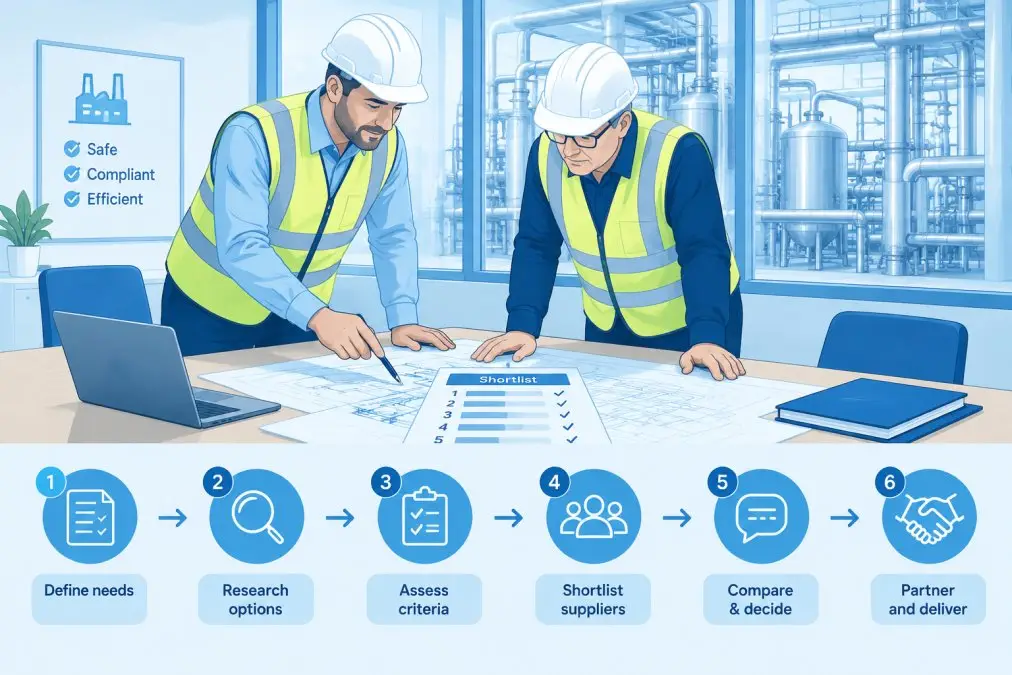
Selection criteria should be scored, not discussed. The five below separate consultancies that will deliver from those that will produce a report and leave.
- Sector evidence. Named projects in your regulated environment, with the client contactable. Score 1 where the firm can name a project and a reference; score 3 where the reference will take a call and the project is within the last three years.
- Mobilisation speed. How quickly a senior person is on site, and who that person is. Score 1 for a named senior engineer within four weeks; score 3 within two weeks with a named individual confirmed in the proposal.
- Scope discipline. How change requests are priced and who signs them off. Score 1 for a written change-control process; score 3 where the process names the approver and the rate for changes is agreed up front.
- Compliance ownership. Whether the firm tracks regulatory change through the engagement or stops at handover. Score 1 for a named owner of regulatory updates; score 3 where the firm provides a written update schedule and names the person accountable for it.
- Exit terms. What you keep at the end: drawings, calculations, as-built records and the reasoning behind decisions. Score 1 for a defined deliverables list; score 3 where the list includes the decision record and the firm confirms you own the intellectual property in the deliverables.
Weight them before you score. Most sites over-weight price and under-weight mobilisation speed, then lose the saving in downtime.
Evidence standard. Ask for named references in your sector, not a client logo wall. Ask how the firm tracks regulatory change and who owns the update when rules shift mid-engagement.
Independent verification. For context on how engineering firms are assessed on competence and quality management, the Institution of Engineering and Technology and BSI’s quality management standards publish guidance worth reading before you shortlist.
Customer outcomes. Concrete delivery evidence beats any pitch document. Our case studies show the projects behind the claims, including work with global organisations such as BP Chemicals, Associated British Foods and Nestlé.
Watch out: scoring a firm highly on sector evidence when the reference is a logo rather than a contactable client is the most common way a shortlist goes wrong, because it rewards marketing rather than delivery.
Weighting of engineering consultancy selection criteria
Engineering Project Delivery: Judging Track Record Before You Appoint
Track record is the hardest claim to verify and the easiest to fake. The practical test is to ask for one project that went wrong and what the firm did next. A consultancy that cannot describe a recovery has either been lucky or is editing.
Ask also whether the firm can join a project already underway. We set out our view on joining a project mid-way separately.
Concrete delivery evidence beats any pitch document. Our case studies show the projects behind the claims, including work with global organisations such as BP Chemicals, Associated British Foods and Nestlé.
For independent context on how engineering firms are assessed on competence and quality management, the Institution of Engineering and Technology and BSI’s quality management standards publish guidance worth reading before you shortlist.
If your current arrangement is costing you time on compliance or slipping on delivery, the fix usually starts with a straight conversation about the actual problem. Ursa Engineering provides practical engineering consultancy for regulated manufacturers, with delivery focused on completing projects on time and within budget.
Frequently Asked Questions
What does March Engineering specialise in, and why would I need alternatives?
March Engineering is known for process, digital and project engineering work across energy and industrial sites. Engineering managers look at March Engineering alternatives when they need a different commercial model, faster mobilisation, deeper sector-specific compliance knowledge, or a consultant who will work alongside an existing site team rather than replace it. The right alternative depends on your project scope, your regulatory obligations and whether you need design, installation, commissioning or ongoing planned maintenance support. Compare providers on verified sector experience and customer outcomes rather than brand size alone.
How do I choose an engineering consultancy for a regulated project?
Start with the regulations that govern your site, such as COMAH duties for petrochemical operations or GMP requirements in pharmaceutical manufacturing, and confirm the consultancy has delivered against them before. Ask for named project examples, the CVs of the people who will actually be on site, and evidence of how they handled a compliance issue mid-project. Check the consultancy’s insurance, its CDM 2015 competence where construction work is involved, and whether it can support you after handover. A short, evidence-based shortlist of three providers beats a long list of brochures.
What should I compare when evaluating engineering service providers?
Use the same criteria for every provider: relevant sector experience, design credentials, project delivery record, approach to business continuity during works, and how they handle scope changes. Ask each one to price the same defined scope so proposals are genuinely comparable, and request references from clients with similar plant size and regulatory exposure. Look at whether they offer ongoing planned maintenance and upgrades or only one-off projects. Transparent comparison criteria stop the decision sliding into a beauty parade of presentations.
How can I assess an engineering consultancy’s experience in manufacturing or pharmaceuticals?
Ask for specific projects in your sector within the last three years, including the site type, the regulatory framework and the outcome. For pharmaceutical work, look for experience with machinery safety, utilities and qualification and validation activities. For food and beverage, check familiarity with hygiene and equipment standards. Speak to at least one reference client directly and ask how the consultancy performed when the scope changed or a compliance question arose. Verifiable customer outcomes carry more weight than a long client logo list.