Last Updated: November 22, 2026
Quick Summary
Engineering project bottlenecks are the single points in a delivery process that limit how fast the whole project moves. Find the constraint by tracing work from request to release, measuring waiting time and queue time, then reduce the stage with the largest impact.
- Trace one piece of work from request to release, including informal stages such as email chases.
- Record waiting time, queue time, cycle time and throughput for each stage over three consecutive weeks.
- Rank constraints by downstream delay caused per person-day of effort needed to fix them.
- Scale the team only when the constraint is capacity-bound and the work is well-defined.
- Assign one owner to each constraint and review queue levels in a weekly 20-minute meeting.
Table of Contents
- What Engineering Project Bottlenecks Are and Why They Persist
- Step 1 to 3: Identifying Bottlenecks by Tracing Work from Request to Release
- Step 4 to 6: Prioritising the Most Consequential Constraint and Reducing It
- Rebuilding the Engineering Project Delivery Timeline Around the Constraint
- Keeping Bottlenecks from Returning in 2026: Ownership and Review Cadence
- Booking Your Bottleneck Review with Ursa Engineering
- Frequently Asked Questions
What Engineering Project Bottlenecks Are and Why They Persist
An engineering project bottleneck is the single point in your delivery process that limits how fast the whole project can move.
Most teams blame effort or talent. In practice, the constraint is usually a handover, an approval queue or one person who holds too many decisions.
Bottlenecks persist because they are often invisible. A late drawing sign-off looks like a design problem, when the real cause is a review queue nobody tracks.
Common causes: dependencies, limited capacity and unclear priorities
- Dependencies: one team cannot start until another finishes a design, permit or piece of equipment data
- Limited capacity: a single specialist, such as a controls engineer or safety reviewer, signs off on everything
- Unclear priorities: several requests are marked urgent, so none of them move quickly
A common mistake is adding resources to the wrong step. Extra engineers do not help if the work is stuck waiting for one approval.
Step 1 to 3: Identifying Bottlenecks by Tracing Work from Request to Release
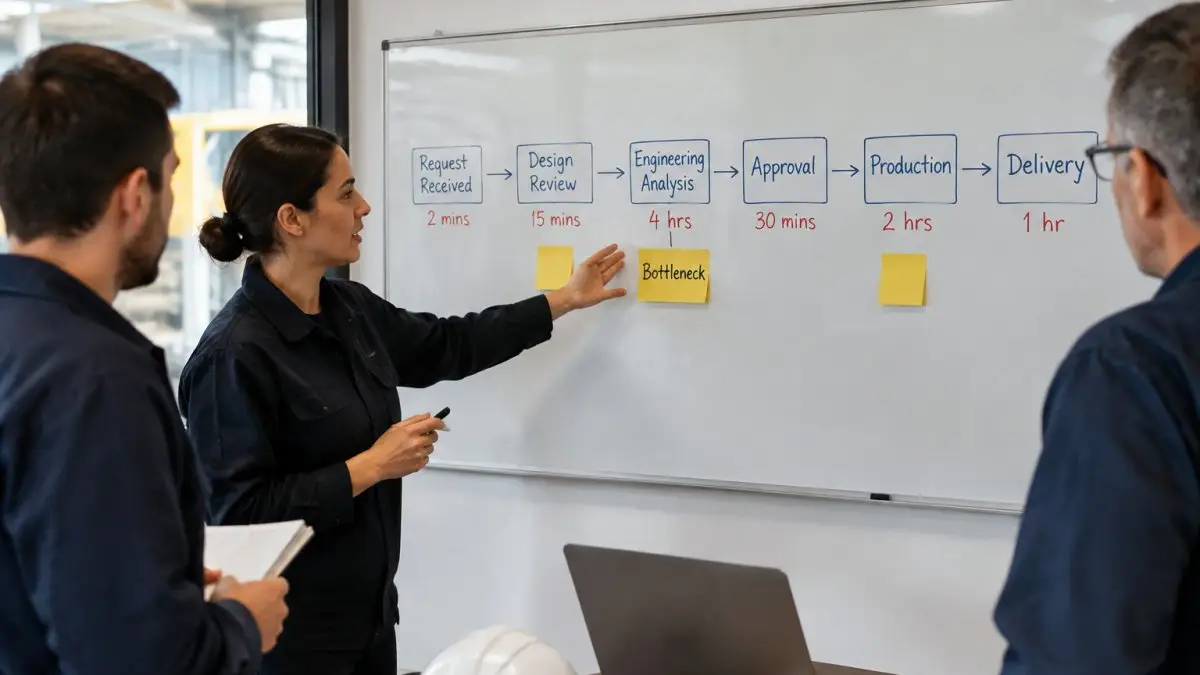
Finding the bottleneck means following one piece of work from the original request all the way to release, then quantifying where it waits.
- Map the path. List every stage a request passes through, from intake to design, review, approval, build, testing and release. Include the informal stages, the corridor conversation, the email chase, the spreadsheet update, because these often hold more waiting time than the formal gates.
- Mark the waiting points. For each stage, note where work sits idle rather than being actively worked on. Record the date work arrived and the date it left. If you cannot find those dates, that absence is itself a finding: the process has no visibility.
- Find the longest queue. The stage with the most waiting work in front of it is your likely constraint. Confirm it by checking whether upstream stages are starved of work while this stage is overwhelmed, a true constraint starves what feeds it and floods what follows it.
Measuring waiting time, queue time and cycle time
You cannot manage what you do not measure, and vague impressions of “slow approvals” will not survive a side-by-side comparison with a team that has numbers. Use four definitions consistently:
- Waiting time: how long work sits untouched between two stages, measured in working hours or days
- Queue time: how many items are waiting ahead of a stage at any moment, and the average age of the oldest item
- Cycle time: how long one item takes from start to finish, including all waiting
- Throughput: how many items a stage completes per week or per month
A worked example makes the arithmetic concrete. Suppose a drawing spends six working days in review but only one day being actively checked. Waiting time is five days, and the ratio of waiting to work is five to one.
Interpret the numbers with two simple rules. First, if queue time is rising while throughput is flat, the constraint is capacity, not effort. Second, if cycle time is long but queue time is short, the constraint is a single slow step rather than a backlog, and adding people elsewhere will not help.
A repeatable 2026 diagnostic
The article defines four measures to use consistently when locating a bottleneck.
| Measure | Definition | Unit |
|---|---|---|
| Waiting time | How long work sits untouched between two stages | Working hours or days |
| Queue time | How many items wait ahead of a stage, and the oldest item’s age | Items and average age |
| Cycle time | Time for one item from start to finish, including waiting | Elapsed time |
| Throughput | Items a stage completes per period | Per week or per month |
Step 4 to 6: Prioritising the Most Consequential Constraint and Reducing It
Once you have found the constraint, rank it by impact rather than by volume of complaint.
- Prioritise with a simple impact score. For each candidate constraint, estimate two numbers: the days of downstream delay it causes each month, and the effort in person-days required to reduce it. Divide delay by effort to get a rough return. A review queue causing ten days of delay a month and needing two person-days to fix scores five; a testing bottleneck causing four days and needing eight person-days scores half a day. Rank by the score, then sanity-check with the people who do the work, because estimates from a spreadsheet miss political and contractual realities.
- Reduce the constraint. Choose the intervention that matches the cause. If the constraint is capacity, add a second reviewer or a back-up approver. If it is batch size, split large review packages into smaller ones so work flows steadily rather than in bursts. If it is policy, pre-agree acceptance criteria so reviews become checks against a known standard rather than open-ended debates. If it is unclear priorities, publish a single ranked list and refuse to mark more than one item urgent per week.
- Check the result and watch for the constraint moving. Re-measure cycle time and queue time after two or three weeks. If the queue has not shrunk, the real constraint is somewhere else. If it has shrunk, expect the constraint to move downstream, this is normal and is the signal that your fix worked. The new constraint is now your priority, and the diagnostic from the previous section should be re-run rather than assumed.
When to scale the team and when to improve the workflow
A common mistake is adding resources to the wrong step.
Speeding up the engineering project approval process
Approval queues cause more delay than most teams expect, and they are where the gap between a good and a poor 2026 workflow is widest. If you are stuck in this stage, see whether engineering consultants can join a project mid-way to unblock delivery. Practical fixes include:
- Set a named approver and a back-up for every stage, so work never waits for one person’s diary
- Agree a review turnaround, such as two working days, and track adherence publicly
- Batch low-risk approvals into a single weekly sign-off to reduce context switching
- Reserve full senior review for changes that affect safety, compliance or cost above an agreed threshold
- Use automated checks for routine compliance evidence so human reviewers focus on judgement, not box-ticking
Watch out: speeding approvals by skipping safety or compliance checks creates far larger delays later, when a fault is found after build, and the cost of rework dwarfs the time saved.
A worked before-and-after pattern
A common pattern in manufacturing and energy projects is a drawing review stage with a five-day wait and a one-day check.
Rebuilding the Engineering Project Delivery Timeline Around the Constraint
Once the constraint is reduced, rebuild your delivery timeline around it. Schedule the constraint’s work first, because everything else must fit around it.
Start with the constraint’s available hours, then plan upstream work to arrive just in time and downstream work to start as soon as it clears.
Review the rebuilt timeline with the people who do the work. They will spot capacity clashes that a planning spreadsheet misses.
For a clear way to re-plan the schedule, see our project management and delivery service. It helps put the revised timeline into practice.
Keeping Bottlenecks from Returning in 2026: Ownership and Review Cadence
Bottlenecks come back when nobody owns them. Assign one person to watch each constraint, and review queue levels at a fixed cadence.
A simple rhythm works well: a weekly 20-minute queue review and a monthly look at cycle time trends. Changing scope is another common source of new constraints, so keep an eye on requests that expand mid-project. Our guide to managing engineering scope creep explains how to control it.
Ongoing oversight is what keeps fixes in place. Our project management service covers this kind of continuing review.
Booking Your Bottleneck Review with Ursa Engineering
If you want an outside view of where your project is stalling, get in touch to discuss how we can help.
Ursa Engineering works with businesses in manufacturing, pharmaceuticals and energy to help deliver projects on time and within budget. Get in touch through our contact page to arrange a review. Find Out More about how we can help your team.
Frequently Asked Questions
What are the most common bottlenecks in engineering projects?
The most frequent bottlenecks are external dependencies, limited specialist capacity, slow approvals and unclear priorities. A dependency on another team or supplier can stall work for days, while a single senior engineer who must review every change creates a queue. Unclear priorities cause teams to start several tasks and finish none. Identifying which of these applies to your project is the first step, because each needs a different fix.
How do you identify a bottleneck in an engineering project?
Trace a typical piece of work from the original request through to release, and record where it waits. Look for the stage where items pile up, where work-in-progress is highest, and where cycle time is longest. The stage with the largest queue, rather than the one where people are busiest, is usually the constraint. Comparing waiting time against active working time at each stage makes the bottleneck clear.
How can engineering teams reduce approval and decision-making delays?
Set a named decision owner and a response time for each approval type, such as two working days for routine design sign-off. Batch approvals into a fixed weekly review rather than ad hoc requests, and pre-agree criteria so reviewers do not need to re-debate standards. Escalate automatically when a decision passes its deadline. These steps usually shorten the approval stage without reducing control.
How can you measure whether a bottleneck has been resolved?
Compare the same measures before and after the change: cycle time from request to release, queue time at the constrained stage, and the number of items waiting. A resolved bottleneck shows shorter queues and more predictable lead times, not just busier people. Measure over several project cycles, because a single good month can reflect a quiet period rather than a structural improvement.