Last Updated: 2 November 2026
Quick Summary
Improving machinery safety in manufacturing plants means closing the gap between written procedures and what actually happens on the floor. Start with a proper machinery risk assessment, enforce guarding and lockout tagout, and use short checklists that get completed honestly.
- PUWER requires equipment to be suitable, maintained in safe condition and used only by trained people.
- Guards and interlocks should be difficult to defeat, not just discouraged from being defeated.
- A five-minute guarding check at shift handover catches most problems before they become incidents.
- The lockout step most often skipped is proving dead, so test for zero energy every time.
- Call or message 07583 079311 to talk to an engineer before your next maintenance shutdown.
Table of Contents
- Why Machinery Safety Failures Still Happen on the Shop Floor
- Start With a Proper Machinery Risk Assessment
- Machine Guarding Requirements You Cannot Skip
- Build a Machinery Safety Checklist That Gets Used
- Lockout Tagout Procedures for Maintenance and Cleaning
- Talk to an Engineer Before Your Next Maintenance Shutdown
- Frequently Asked Questions
Why Machinery Safety Failures Still Happen on the Shop Floor
Most machinery incidents do not come from a single catastrophic failure. They come from small, familiar shortcuts that everyone has seen a hundred times. Across plants, the same pattern shows up again and again: guards removed for a quick clean, isolation skipped because “it’s only a two-minute job”, and risk assessments filed away and never opened again.
That gap between what the paperwork says and what actually happens on the floor is where machinery safety breaks down. Improving machinery safety in manufacturing plants is less about buying new equipment and more about closing that gap, systematically.
The most common causes we come across:
- Guards removed or bypassed to clear jams faster
- Interlocks defeated with tape, cable ties or a spare key
- Isolation procedures that exist on paper but not in practice
- Risk assessments written once and never reviewed
- Maintenance staff under pressure to get lines running again
None of these are deliberate. They are what happens when procedures are written for the file rather than for the person doing the job.
If you recognise your own plant in that list, you are not alone. The fix starts with a proper look at where the real risks sit.
Start With a Proper Machinery Risk Assessment
A machinery risk assessment is a structured look at every hazard a machine presents, who could be harmed, and what controls reduce that risk to an acceptable level. It is the foundation for everything else, and it must reflect how the machine is actually used, cleaned and maintained.
The legal backbone here is the Provision and Use of Work Equipment Regulations 1998 (PUWER), enforced by the Health and Safety Executive’s guidance on work equipment. PUWER requires that equipment is suitable, maintained in safe condition, and used only by trained people.
What a Risk Assessment Must Cover
A useful assessment goes well beyond the normal running of the machine. It needs to cover:
- Every life stage: installation, operation, cleaning, maintenance, fault-finding and decommissioning
- Every person exposed: operators, cleaners, maintenance engineers, contractors and visitors
- Each hazard type: entanglement, crushing, shearing, cuts, ejection, noise, vibration, electricity and stored energy
- Existing controls: what is in place now, and whether it actually works
- Residual risk: what remains after controls, and whether that is tolerable
Watch out: the biggest mistake is having the assessment written by someone who never touches the machine. The people who run and maintain it know where the real exposure sits. Involve them.
For plants juggling new automation alongside existing lines, the compliance and design work can be substantial.
Machine Guarding Requirements You Cannot Skip
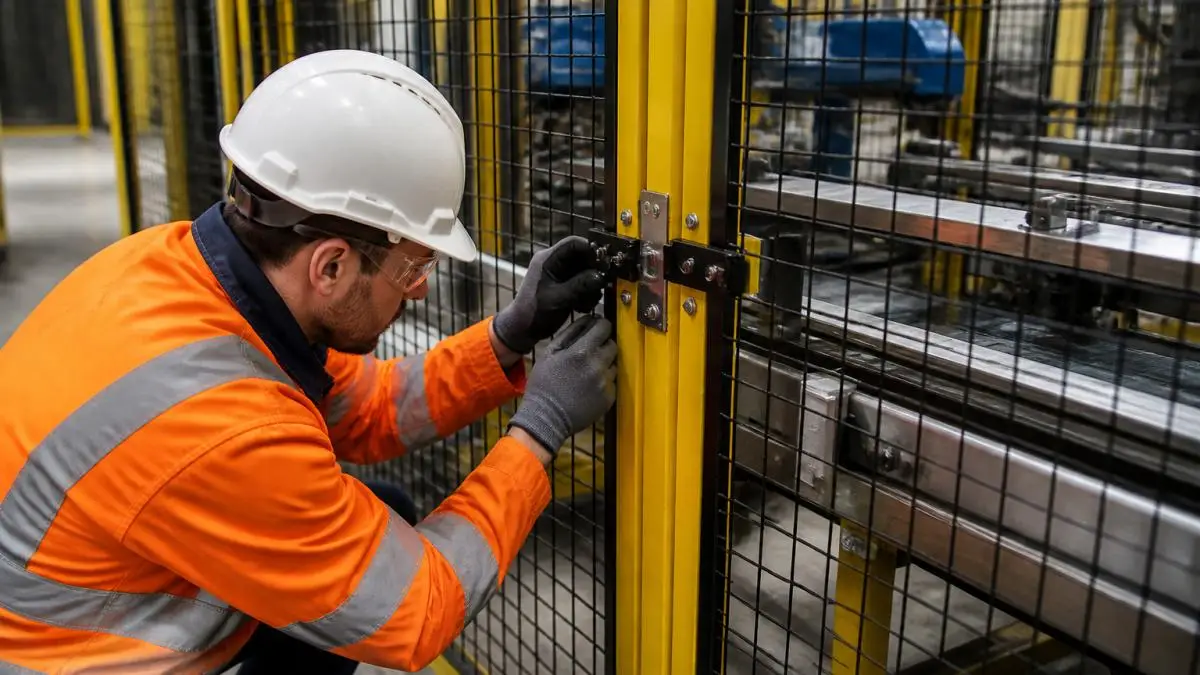
Guarding is the most visible control, and the one most often compromised. Machine guarding requirements under PUWER are clear: dangerous parts must be protected, and guards must not be easily defeated.
What that means in practice:
- Fixed guards for hazards that need no routine access
- Interlocked guards that stop the machine before access is possible
- Hold-to-run controls where full guarding is not practical
- Regular checks that guards are in place, secure and working
The HSE is blunt on this point: guards and interlocks should be difficult to defeat, not just discouraged from being defeated. If a guard can be removed with a single spanner and no one notices, it is not doing its job.
The practical answer is a guarding check built into shift handover, not a yearly audit. A five-minute walk that confirms every guard is fitted and every interlock trips correctly catches most problems before they become incidents.
Build a Machinery Safety Checklist That Gets Used
A machinery safety checklist only works if it is short enough to complete honestly. Long, generic checklists get ticked without looking.
Here is a workable daily and weekly structure:
| Check | Frequency | Who | What “good” looks like |
|---|---|---|---|
| Guards fitted and secure | Each shift | Operator | All guards present, no missing fixings |
| Interlocks trip correctly | Daily | Supervisor | Machine stops on guard opening |
| Emergency stops tested | Weekly | Maintenance | All E-stops function and reset |
| Isolation points accessible | Monthly | Engineering | Switches reachable and labelled |
| Risk assessment reviewed | Annually or on change | Safety lead | Reflects current setup |
Keep the language plain. “Guard secure? Yes or no” beats a paragraph of criteria. And make sure the person signing it is the person who actually looked.
Lockout Tagout Procedures for Maintenance and Cleaning
Cleaning and maintenance are where most serious injuries occur, because that is when guards come off and hands go near dangerous parts. Lockout tagout procedures exist to make sure a machine cannot restart while someone is working on it.
This is not optional good practice. PUWER requires that equipment is isolated and locked off before maintenance where unexpected start-up could cause injury.
The Six Steps of a Workable Lockout Sequence
- Identify every energy source: electrical, pneumatic, hydraulic, gravity, stored pressure
- Notify affected operators that the machine is going down
- Shut down using the normal stopping procedure
- Isolate each energy source at its isolation point
- Lock and tag with a personal lock and a clear tag naming who and why
- Prove dead by testing for zero energy before starting work
Watch out: the step most often skipped is proving dead. Test the isolation point every time, even if you isolated it yourself an hour ago.
If your procedures have drifted from practice, it is worth reviewing them against what actually happens on the floor. You can see how bespoke isolation safety training and procedure updates were delivered for a client.
Talk to an Engineer Before Your Next Maintenance Shutdown
Shutdowns are where safety shortcuts cost the most. Time pressure is high, contractors are on site, and isolation discipline gets tested. Getting an experienced eye on the plan before the shutdown starts is far cheaper than discovering the gap mid-job.
That is exactly what our free WhatsApp line is for. Talk to an engineer with decades of hands-on experience who understands what actually needs to happen on a plant floor, not just what the checklist says. Call or message 07583 079311 and describe the job.
If you would rather understand where responsibility sits before you commit to decisions, our guide to duty holder responsibilities sets out what the law expects of you. For broader support across compliance and project delivery, see our manufacturing engineering solutions.
Machinery safety does not improve through paperwork alone. It improves when the procedures match the work, the checks are short enough to be honest, and someone with real experience looks at the risks with you. Ursa Engineering brings decades of hands-on industry experience across manufacturing, pharmaceuticals and energy, with a practical, no-nonsense approach that fits how your plant actually runs. Get in touch with Ursa Engineering to put your safety controls on a firmer footing before the next shutdown.
Frequently Asked Questions
How often should machinery risk assessments be reviewed?
Review them at least annually, and immediately after any modification, relocation, change of process or near miss. The Provision and Use of Work Equipment Regulations 1998 require equipment to stay suitable and safe throughout its life, so a review is also due when the manufacturer’s instructions change or when new operators take over the machine. Record the date, the findings and the actions taken. If nothing has changed, a short documented re-check is enough; if guarding or control systems have been altered, treat it as a full reassessment.
What should a machinery safety checklist include?
A workable machinery safety checklist covers guards and interlocks, emergency stops, isolation points, warning signage, control panel condition, hydraulic and pneumatic leaks, and the competence records of the people running the line. Add a section for housekeeping around the machine and a sign-off column with a name and date. Keep it to one or two pages per machine so operators actually complete it. Anything that fails should trigger a written defect report and a decision on whether the machine keeps running.
What UK regulations apply to machinery safety in manufacturing?
The main duties sit under the Health and Safety at Work etc. Act 1974, the Provision and Use of Work Equipment Regulations 1998 (PUWER), the Supply of Machinery (Safety) Regulations 2008, and the Management of Health and Safety at Work Regulations 1999 for risk assessment. The Electricity at Work Regulations 1989 apply to control systems, and COSHH covers cleaning chemicals used during maintenance. Enforcement sits with the Health and Safety Executive and local authorities. Machinery safety compliance means evidence, not just intention, so keep assessment records, maintenance logs and training files.
How do you manage machinery safety during maintenance and cleaning?
Isolate the machine from every energy source, including electrical, pneumatic, hydraulic and gravity, then prove the isolation before anyone reaches in. Apply personal locks and tags, and never rely on a single key or a verbal instruction. Cleaning crews need the same protection as fitters, so include them in the lockout tagout procedures and the training. Where full isolation is impractical, use a permit-to-work system with a named authorised person. A free call to an experienced engineer on 07583 079311 can help you sense-check your sequence before the next shutdown.