Quick Summary
Machinery safety compliance requirements in the UK are legal duties covering both supply and use. Suppliers must meet the Supply of Machinery (Safety) Regulations 2008, while employers must keep work equipment safe under PUWER 1998, including documented risk assessments and guarding.
- Product-supply rules under the Supply of Machinery (Safety) Regulations 2008 apply before machinery is sold or put into service.
- PUWER 1998 governs how employers keep work equipment safe once employees use it.
- A documented PUWER risk assessment is the core tool for showing how hazards were identified and controlled.
- Technical files are generally kept for ten years from the date the machinery was placed on the market.
- Confirm the destination market, declaration, marking and language before any machine is supplied or moved.
Table of Contents
- Why Machinery Safety Compliance Matters in the UK
- The Supply of Machinery (Safety) Regulations 2008: Scope and Purpose
- PUWER Risk Assessment: Identifying and Reducing Hazards
- Machine Guarding Requirements and Protective Devices
- Conformity Assessment, Technical Files and Declarations
- Choosing the Right Route: GB, Northern Ireland or EU Requirements
- Used, Imported and Modified Machinery: What Changes
- Machinery Safety Inspection Frequency and Records
- PUWER Inspection Checklist and Next Steps for Your Plant
- Frequently Asked Questions
Why Machinery Safety Compliance Matters in the UK
Last Updated: 17 November 2026
Machinery safety compliance requirements in the UK are not optional paperwork. They are legal duties that apply to anyone who designs, supplies, installs or uses machinery at work. A plant that treats compliance as a box-ticking exercise often ends up with unguarded machines, incomplete records and a costly enforcement visit.
Machinery safety compliance requirements in the UK sit across several overlapping regimes. Product-supply rules set what must be true before a machine is sold or put into service. Workplace-use rules, chiefly the Provision and Use of Work Equipment Regulations 1998 (PUWER), govern how that equipment is kept safe once employees are working with it. Keeping the two separate in your head makes the rest of this guide much easier to follow.
The practical stakes are straightforward. Machinery accidents are among the most serious causes of injury in manufacturing, and a compliant, well-documented machine is far easier to defend after an incident than one with missing records. In many cases, gaps are not technical failures. They are often missing paperwork, unclear responsibilities and inspections that drifted out of schedule.
Watch out: a machine bought second-hand is not exempt from workplace duties just because the original manufacturer carried out its own conformity work years ago.
The Supply of Machinery (Safety) Regulations 2008: Scope and Purpose
The Supply of Machinery (Safety) Regulations 2008 set the health and safety requirements that machinery must meet before it is placed on the market or put into service in Great Britain (The Supply of Machinery (Safety) Regulations 2008). They implement the wider framework for product safety and are the starting point for anyone supplying equipment.
The Regulations apply to new machinery and to certain components supplied separately. Their purpose is to ensure that machinery meets the essential health and safety requirements (EHSRs) before it reaches a user, so that hazards are designed out or controlled at source. Compliance is demonstrated through conformity assessment, technical documentation and a Declaration of Conformity or Declaration of Incorporation.
Machinery, partly completed machinery and safety components covered
The Regulations cover three broad categories. Machinery is an assembly of linked parts with at least one moving part, designed for a specific application. Partly completed machinery is an assembly that cannot function alone and is intended for incorporation into another machine, and it is supplied with a Declaration of Incorporation rather than a full Declaration of Conformity. Safety components are items placed on the market to fulfil a safety function, such as light curtains or emergency stop devices, and they are supplied separately.
Confirm the category of each item before you buy or supply it. The paperwork you need depends entirely on which category applies.
Who is responsible when machinery is supplied
Responsibility sits with the economic operators in the supply chain. The manufacturer designs and builds the machine and carries out conformity assessment. Where the manufacturer is based outside Great Britain, an authorised representative or importer must make sure the machine meets the requirements before it is placed on the market. Distributors and suppliers must check that the required documentation and marking are present before they pass the machine on.
The employer who puts the machine into service at work has separate duties under PUWER, regardless of what the supplier has done. A compliant machine can still be used unsafely, so the two sets of obligations must be managed together.
PUWER Risk Assessment: Identifying and Reducing Hazards
The Provision and Use of Work Equipment Regulations 1998 require employers to ensure that work equipment is suitable for its intended use, maintained in good repair and used safely (Provision and Use of Work Equipment Regulations 1998 (PUWER) – overview). A documented PUWER risk assessment is the core tool for meeting these duties, because it shows how you identified each hazard and what you did about it.
A sound PUWER risk assessment follows a clear sequence. Ursa’s assessment service uncovers hazards and inefficiencies on site, so you can see where risks sit before you start the process. Identify the hazards associated with each machine, including trapping, entanglement, ejection and contact with moving parts. Decide who could be harmed and how. Evaluate the existing controls and whether they are adequate. Then reduce the remaining risk, starting with the most effective controls and working down to personal protective equipment.
Treat the assessment as a living document. It should change whenever the machine, its guarding or the way people use it changes.
Machine Guarding Requirements and Protective Devices
Guarding is where many plants fall short. Under PUWER, dangerous parts of machinery must be safeguarded, and the guarding must prevent access to those parts while the machine is running (Provision and Use of Work Equipment Regulations 1998 (PUWER) – overview). Fixed guarding is generally the most robust approach, supported where necessary by interlocked guards and presence-sensing devices such as light curtains.

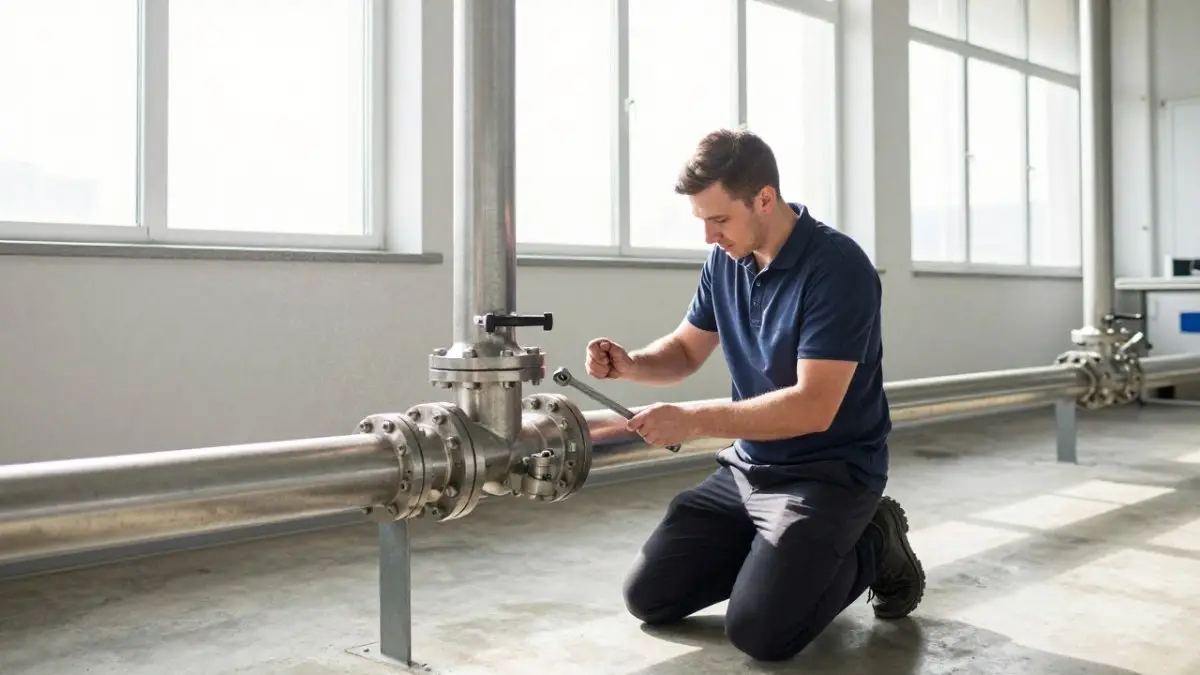
A maintenance engineer inspecting a fixed guard and interlocked access door on a production line is a routine part of this work, and the inspection should confirm that each guard is secure, that interlocks stop the machine when a guard is opened, and that no one has bypassed a device to keep production moving.
Protective devices must be maintained and tested, not simply installed. Record the test, the result and the person who carried it out.
Conformity Assessment, Technical Files and Declarations
Conformity assessment is the process by which the manufacturer shows that the machine meets the essential health and safety requirements. For many machines this involves an internal production control procedure. For certain higher-risk machinery listed in the Regulations, a notified body must be involved. Either way, the outcome must be documented, and the technical file is the evidence that supports the declaration.
The technical file is not a single certificate. It is a structured pack that should allow an enforcement officer or a notified body to reconstruct how the manufacturer reached the conclusion that the machine conforms. A defensible file typically contains: Ursa’s compliance and maintenance services can help you assemble and keep these documents current.
- A general description of the machinery and its intended use
- Overall and detailed drawings, including guarding and control schematics
- The risk assessment, showing each hazard identified and the measures taken
- The list of harmonised standards applied, or other standards relied on where no harmonised standard exists
- Test reports and calculation notes
- Instructions for use and safety information, including the language versions supplied
- For partly completed machinery, the assembly instructions and the Declaration of Incorporation
- A copy of the Declaration of Conformity or Declaration of Incorporation
- Evidence of the conformity assessment procedure followed, including notified body involvement where required
The manufacturer must keep the technical file available for the period set out in the Regulations, which is generally ten years from the date the machinery was placed on the market. The file must be held in a form that can be produced for inspection, and it must be available to the market surveillance authority on request.
Watch out: a technical file that contains only a Declaration of Conformity and a generic manual is not a technical file. The risk assessment and the drawings are the parts enforcement officers ask for first, and a file without them is difficult to defend even where the machine itself is well guarded.
A Declaration of Conformity states that a complete machine meets the requirements and is accompanied by the CE or UKCA marking, depending on the market. A Declaration of Incorporation applies to partly completed machinery and states that it must not be put into service until the machine it is incorporated into has been shown to conform.
For importers and distributors, the practical duty is to check that the declaration and the technical file exist and match the machine. You do not need to hold the full technical file in every case, but you should be able to obtain it from the manufacturer or authorised representative on request, and you should know who to ask.
Choosing the Right Route: GB, Northern Ireland or EU Requirements
Most compliance confusion we see does not come from the technical requirements themselves. It comes from applying the wrong regime to the wrong destination. A machine can be fully conformant for one market and non-compliant for another, and the paperwork, marking and declaration must match the route the machine is actually taking.
Use the destination of the machine, not the location of your business, as the starting point. For a related read on managing these obligations, see Managing Regulatory Compliance in Pharmaceutical Manufacturing. The table below sets out the three routes in practical terms.
| Destination | Governing regime | Marking | Declaration |
|---|---|---|---|
| Great Britain (England, Scotland and Wales) | Supply of Machinery (Safety) Regulations 2008 | UKCA marking, with CE marking accepted for most machinery placed on the GB market under the current arrangements | Declaration of Conformity or Declaration of Incorporation |
| Northern Ireland | EU machinery rules as they apply under the Windsor Framework | CE marking | EU Declaration of Conformity or Declaration of Incorporation |
| European Union | EU Machinery Directive and its successor Regulation | CE marking | EU Declaration of Conformity or Declaration of Incorporation |
A common pattern is a manufacturer building to EU requirements and assuming the same file and marking will satisfy a GB customer. In many cases the technical content overlaps heavily, but the declaration must name the correct legislation and the marking must be the one accepted for that market. Ask the supplier to state the route in writing on the quotation or order confirmation, and check that the declaration cites the regime for the destination you are supplying into.
Watch out: a machine carrying both UKCA and CE marking is not automatically compliant for every destination. The declaration and technical file must still support the route being used, and a marking applied without the corresponding assessment is a paperwork failure that enforcement officers treat seriously.
For distributors and importers, the check is straightforward but easy to skip. Confirm the destination market before the order is placed, confirm the declaration cites the correct legislation, confirm the marking matches that route, and confirm the instructions and safety information are in the language required for the destination. If any of those four checks fails, stop and resolve it before the machine moves.
Where a machine is being moved between these markets after first supply, the position can change. A machine placed on the GB market and later moved to Northern Ireland may need to meet the EU route, and the reverse can also apply. Treat cross-border movement as a fresh supply question rather than assuming the original paperwork travels with the machine.
Used, Imported and Modified Machinery: What Changes
Second-hand, refurbished and imported machinery raises particular questions. A used machine does not need a new Declaration of Conformity when it changes hands, but the workplace duties under PUWER apply in full to the user. Where a machine has been substantially modified, the modifier may take on the obligations of a manufacturer, so the modification must be assessed and documented properly.
Imported machinery needs an authorised representative or importer with a clear responsibility for compliance. Ask for the technical file or at least the Declaration and evidence of conformity before accepting delivery.
Machinery Safety Inspection Frequency and Records
There is no single fixed inspection interval that suits every machine. Under PUWER, the frequency depends on the risk and the manufacturer’s recommendations (Inspection of work equipment). Higher-risk machines and guarding should be inspected more often, and any machine that has been repaired, modified or involved in an incident should be inspected before it returns to use.
Records are as important as the inspections themselves. Keep a register for each machine showing the date of each inspection and test, the findings, the corrective actions and who signed them off. Records that show a consistent, responsive process are far easier to defend than a single impressive document that was never updated.
PUWER Inspection Checklist and Next Steps for Your Plant
Use the checklist below as a starting point for your own plant. Adapt it to the machines and risks you actually have.
- Every machine has a current PUWER risk assessment that reflects how it is really used
- Dangerous parts are guarded, and guards cannot be removed or bypassed without tools
- Interlocks and presence-sensing devices are tested at defined intervals and the results are recorded
- Each item of machinery has a Declaration of Conformity or Declaration of Incorporation as appropriate
- Technical files are available for inspection and held for the required period
- Used or modified machinery has been assessed and documented before it returns to service
- Inspection and maintenance records are kept in a single, up-to-date register
- Responsibilities for each machine are named, including who checks guarding and who signs off repairs
Start with the machines carrying the highest risk and work down the list. If your team is stretched, or you are unsure whether your documentation would stand up to an inspection, Ursa Engineering can review your position and help you close the gaps. Get in touch with our compliance specialists to discuss your plant, or review our duty holder support to see how we take on those obligations for you.
Machinery safety compliance requirements in the UK are manageable when the responsibilities are clear and the records are kept current. Ursa Engineering helps engineering managers and compliance officers put practical, auditable systems in place without adding unnecessary bureaucracy. Get in touch to find out how we can support your site.
Frequently Asked Questions
What are the main machinery safety compliance requirements?
Machinery safety compliance in the UK rests on two main pillars. The Supply of Machinery (Safety) Regulations 2008 set out the essential health and safety requirements that machinery must meet before it is placed on the market, along with conformity assessment, technical documentation and the Declaration of Conformity or Incorporation. The Provision and Use of Work Equipment Regulations 1998 (PUWER) then apply to employers who use work equipment, requiring suitable equipment, risk assessment, guarding, inspection and training. Both sets of duties apply in practice, and an organisation can hold responsibilities under each depending on whether it supplies or uses the machinery.
What does PUWER require employers to do?
PUWER requires employers to ensure that work equipment is suitable for its intended use, maintained in an efficient state, in good repair and inspected where the risk justifies it. Employers must control access to dangerous parts, provide suitable guarding and controls, give adequate information, instruction and training, and carry out a risk assessment where a risk to health or safety exists. Equipment must also be used only by people who have received appropriate training. Compliance is demonstrated through records of inspection, maintenance and training rather than through paperwork alone.
What is the difference between PUWER and the Supply of Machinery (Safety) Regulations 2008?
The Supply of Machinery (Safety) Regulations 2008 apply to those who design, manufacture, import, or place machinery on the market in Great Britain, and they focus on the design and conformity of the product. PUWER applies to employers and others who use work equipment, and it focuses on how that equipment is selected, maintained, inspected and operated in the workplace. A business that buys a new machine must consider both: the supplier should provide conformity documentation under the 2008 Regulations, and the employer must still meet its PUWER duties when the machine is used on site.
When is a machinery risk assessment required?
A risk assessment is required where work equipment presents a risk to the health or safety of people, which in practice covers most powered machinery. Under PUWER, the assessment should identify hazards, evaluate the risks, and determine the measures needed to control them, such as guarding, safe systems of work, training or maintenance. It should be reviewed when equipment changes, when accidents or near misses occur, or when the way the machine is used changes.