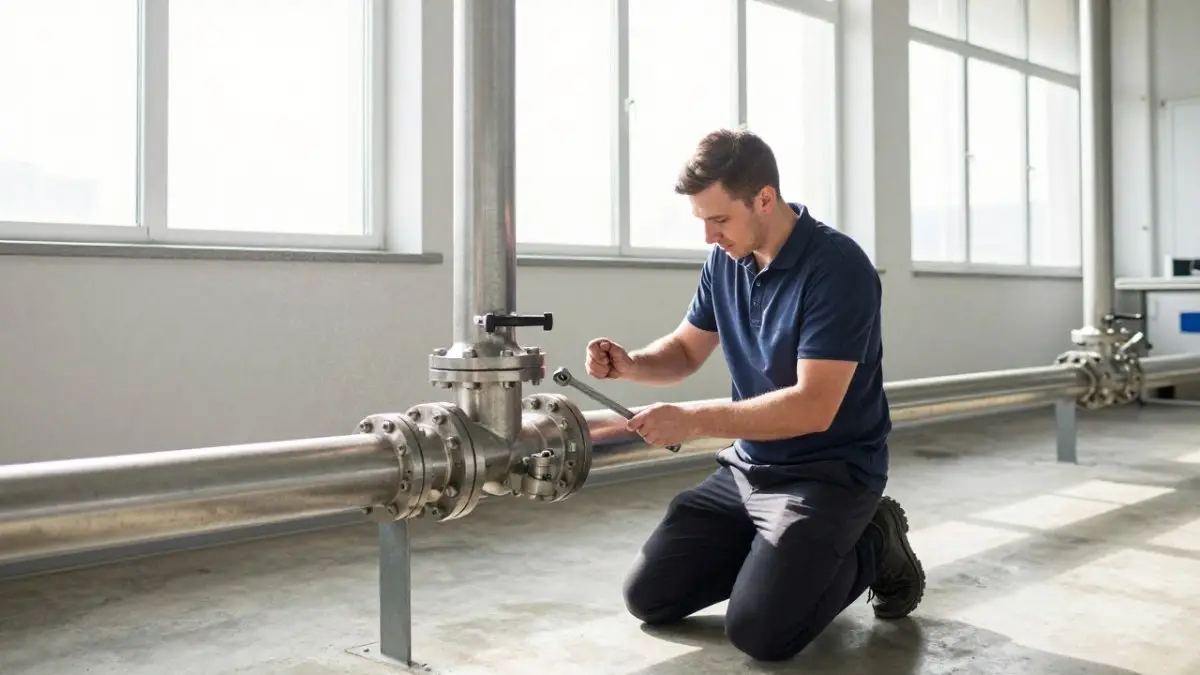
Last Updated: 2 November 2026
Quick Summary
A pharmaceutical machinery safety compliance checklist in 2026 is a documented set of verified controls covering guarding, emergency stops, validation status, inspection intervals and records, each traceable to a named regulation and a named owner. It is the evidence file you hand to an inspector, an auditor or a client, not a tick-box form.
- Five pieces of legislation do most of the work, with the Health and Safety at Work etc. Act 1974 as the foundation.
- A PUWER inspection checklist covers six areas, including guarding and interlocks, emergency stops and operator training records.
- Test emergency stops under load, not just at rest, and photograph the guard in place with the record.
- Any modification, whether a new guard or a firmware update, should trigger a documented review of validation status.
- Treat reinstallation of a used machine as a new commissioning exercise and re-run the relevant validation steps.
Table of Contents
- What the 2026 Pharmaceutical Machinery Safety Compliance Checklist Must Cover
- Which UK Regulations Govern Pharmaceutical Machinery Safety
- Building a Machinery Risk Assessment Template That Works on Site
- The PUWER Inspection Checklist for Production Machinery
- A Pharmaceutical Equipment Validation Checklist for New and Modified Plant
- Used Pharmaceutical Equipment Inspection Before You Buy or Reinstall
- Records, Review Cycles and How Often Checks Should Run
- Common Mistakes That Undermine Machinery Safety Compliance
- Getting Your 2026 Compliance Checklist Reviewed by Ursa Engineering
- Frequently Asked Questions
What the 2026 Pharmaceutical Machinery Safety Compliance Checklist Must Cover
A pharmaceutical machinery safety compliance checklist in 2026 is a documented set of verified controls covering guarding, emergency stops, validation status, inspection intervals and records, each traceable to a named regulation and a named owner. It is not a tick-box form. It is the evidence file you hand to an inspector, an auditor or a client when they ask how you know the plant is safe.
Ursa Engineering provides engineering consultancy for manufacturers in regulated industries, and a common gap is that sites hold plenty of paperwork but cannot prove it matches the machine in front of them. A working checklist is one way to close that gap.
Below, we break down what a working checklist contains, which regulations drive it, and how to keep it current when equipment and rules change.
Which UK Regulations Govern Pharmaceutical Machinery Safety
Five pieces of legislation do most of the work: the Supply of Machinery (Safety) Regulations 2008, the Provision and Use of Work Equipment Regulations 1998 (PUWER), the Control of Substances Hazardous to Health Regulations, and the Electricity at Work Regulations 1989. Add the Health and Safety at Work etc. Act 1974 as the foundation, and you have the statutory spine of any pharmaceutical machinery safety compliance checklist.
Each one asks a different question. The Supply of Machinery (Safety) Regulations govern what a machine must be when it is first placed on the market or put into service, including CE marking and the technical file. PUWER governs the machine in use: guarding, training, maintenance, inspection. COSHH covers exposure to hazardous substances during cleaning and operation. The Electricity at Work Regulations cover the fixed installation and portable equipment testing.
The Health and Safety Executive’s PUWER guidance sets out the practical duties in plain terms, and it is the document most inspectors will reference first. Read it before you draft anything.
Building a Machinery Risk Assessment Template That Works on Site
Most risk assessments fail because they are written for the file, not for the shop floor. A template that works on site has four properties: it names the task, not just the machine; it records the severity and likelihood of each hazard; it states the control in plain language; and it carries a signature and a review date.
Here is the structure we use:
| Field | What goes in it | Why it matters |
|---|---|---|
| Task and location | Specific operation, room, line | Hazards differ by task, not by asset |
| Hazard and harm | What could happen and to whom | Drives the severity score |
| Existing controls | Guarding, interlocks, procedures | Proves current state |
| Residual risk | Score after controls | Justifies any remaining risk |
| Action and owner | Named person, date | Makes it actionable |
| Review date | Typically annual or on change | Keeps it live |
Watch out: the most common failure is a template that scores risk but never records who closed the action. See how machinery safety assessments and audits work in practice on a live automation project. An unsigned action is an open liability.
For current details of Ursa Engineering’s machinery safety work, visit the company website.
The PUWER Inspection Checklist for Production Machinery
A PUWER inspection checklist covers six areas: guarding and interlocks, emergency stops, control systems, isolation and lock-off points, warning signage, and operator training records. Inspect each machine against all six, record the result, and date the entry.
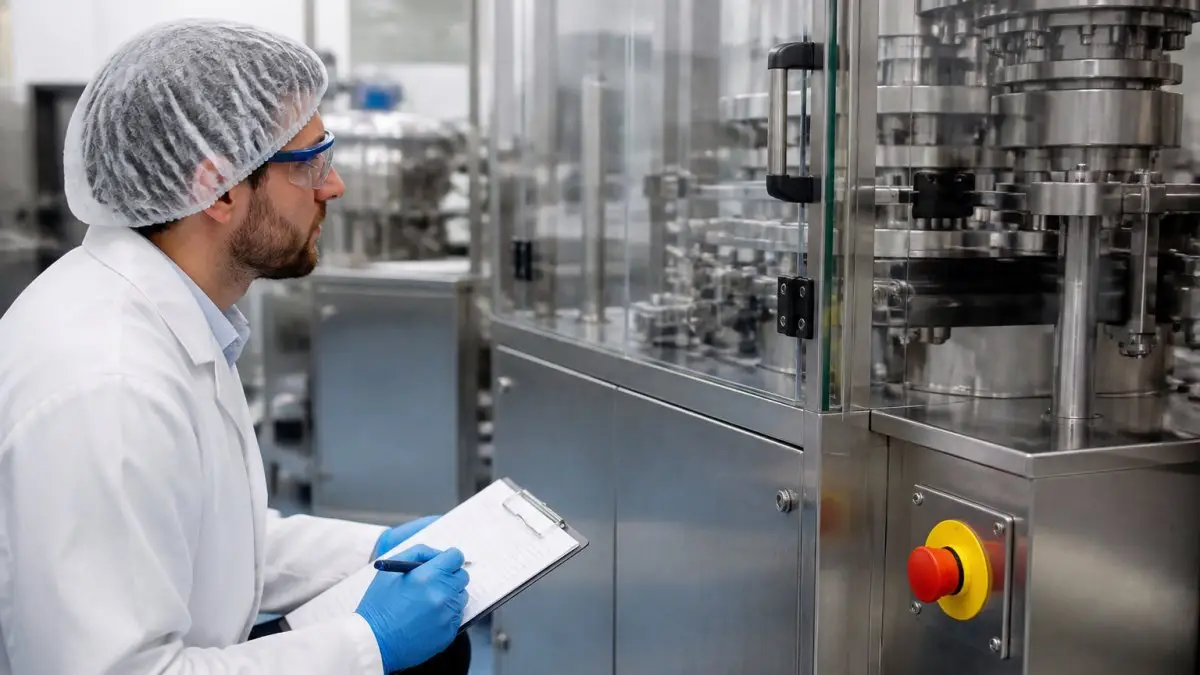
The HSE’s guidance on workplace equipment inspection is clear that inspection frequency should follow risk, manufacturer guidance and the intensity of use, not a fixed calendar. A tablet press running three shifts needs closer attention than a packaging line running one.
Two practical points. First, test the emergency stop under load, not just at rest. Second, photograph the guard in place and file the image with the record. When an inspector asks whether the guard was fitted, a dated photograph answers faster than a signature.
A Pharmaceutical Equipment Validation Checklist for New and Modified Plant
Validation is where pharmaceutical machinery safety compliance meets product quality. A pharmaceutical equipment validation checklist should cover installation qualification, operational qualification, performance qualification, change control and revalidation triggers.
Installation qualification confirms the machine is built and installed as specified: utilities, services, documentation and safety devices. Operational qualification proves it works across its intended operating range, including alarms and interlocks. Performance qualification demonstrates it produces consistent output under production conditions.
The critical point most sites miss is change control. Any modification, whether a new guard, a firmware update or a re-rated motor, should trigger a documented review of the validation status. A safety device changed without revalidation is both a quality and a compliance gap.
Used Pharmaceutical Equipment Inspection Before You Buy or Reinstall
Buying second-hand plant is a false economy if the inspection is thin. Before you commit, inspect the machine’s history, its safety devices, its guarding, its electrical condition and its documentation. A used pharmaceutical equipment inspection should answer one question: can this machine be brought into compliant service, and at what cost?
Start with the technical file. If the original declaration of conformity and manual are missing, you are rebuilding compliance from scratch. Then inspect the physical state: guard condition, interlock function, emergency stop operation, control panel integrity, and signs of modification.
Reinstallation is not a like-for-like swap. Moving a machine changes its risk profile: new services, new layout, new operator access. Treat reinstallation as a new commissioning exercise and re-run the relevant validation steps.
Records, Review Cycles and How Often Checks Should Run
Records are the difference between a claim and evidence. Every inspection, risk assessment, validation and training entry should carry a date, a named person and a clear outcome. Keep them retrievable for the period your quality system requires, and make sure the version on file matches the version in use.
Review cycles should follow risk, not habit. High-risk machinery with frequent use typically warrants more frequent inspection; low-risk, lightly used equipment can run longer intervals. Whatever interval you choose, document the reasoning.
If managing that cycle in-house strains your team, Ursa Engineering can be contacted to discuss how it might help.
Common Mistakes That Undermine Machinery Safety Compliance
The same failures recur across sites. A risk assessment written once and never reviewed. Guards removed for maintenance and never refitted. Training records that name a course but not the machine. Emergency stops tested at rest only. Change control bypassed for “minor” modifications. Documentation held in three places and matching in none.
Training gaps sit behind most of these. Operators who do not know what a guard interlock does will defeat it when it slows them down. Operator training is an important part of that, because a checklist is only as good as the people following it. Ursa Engineering offers engineering compliance training to close those gaps.
Getting Your 2026 Compliance Checklist Reviewed by Ursa Engineering
A checklist is a living document, and regulations move. Ursa Engineering brings hands-on industry experience across regulated manufacturing and has worked with global organisations including BP Chemicals, Associated British Foods and Nestlé. The team focuses on practical, no-nonsense solutions.
For the specialist view on what your sector demands, visit the Ursa Engineering website.
Ready to have your checklist reviewed? Get in touch with Ursa Engineering to discuss your requirements.
Pharmaceutical machinery safety compliance is not a document you write once and file. It is a cycle of assessment, inspection, validation and review that has to survive staff changes, equipment modifications and shifting regulation. Ursa Engineering provides engineering consultancy for regulated manufacturers, focused on practical, compliant and efficient project delivery. Visit the Ursa Engineering website to discuss how it can support your checklist.
Frequently Asked Questions
What should a pharmaceutical machinery safety checklist include?
A workable checklist covers guarding and interlocks, emergency stop testing, isolation and lock-off points, control system function, pressure and temperature safety devices, warning signage, and operator training records. Add a named owner and review date for each line. In pharmaceutical plants, cross-reference each item to your pharmaceutical machinery safety risk assessment so safety checks and GMP controls are not run as two separate systems.
Which UK regulations apply to machinery safety in pharmaceutical manufacturing?
The core duties sit with the Provision and Use of Work Equipment Regulations 1998 (PUWER), supported by the Supply of Machinery (Safety) Regulations 2008, the Management of Health and Safety at Work Regulations 1999, and the Control of Substances Hazardous to Health Regulations 2002 where dusts or solvents are present. GMP obligations under the Human Medicines Regulations 2012 run alongside these, not instead of them.
How often should pharmaceutical machinery safety checks be carried out?
Frequency should follow risk, not habit. High-risk equipment such as tablet presses, coating pans and autoclaves typically need documented checks before each shift or campaign plus a fuller inspection at defined intervals. Lower-risk items can run quarterly or annually. PUWER requires inspection at suitable intervals and after any modification or relocation, so set intervals in the risk assessment and record the basis for each one.
What records should be kept for pharmaceutical machinery compliance?
Keep the risk assessment, inspection and test records with dates and signatures, maintenance and calibration logs, validation documentation, training records, incident and near-miss reports, and evidence of corrective actions closed out. Records should be retrievable for at least the period your quality system specifies, and ideally for the working life of the equipment. A checklist with no completed records behind it will not stand up to scrutiny.
How can manufacturers verify the safety of used pharmaceutical equipment?
Commission a documented used pharmaceutical equipment inspection before purchase or reinstallation. That means checking the CE marking and declaration of conformity, confirming guarding and interlocks are intact, reviewing service history, testing emergency stops and isolation points, and assessing whether the control system meets current standards. Reinstallation usually triggers a fresh risk assessment and validation, so budget for that from the start.
What is the difference between machinery safety compliance and GMP compliance?
Machinery safety compliance under PUWER focuses on protecting people from the equipment: guarding, controls, isolation and maintenance. GMP compliance focuses on product quality and consistency: validation, cleaning, data integrity and traceability. They overlap heavily, particularly on change control and documentation, but passing one does not demonstrate the other. A single integrated checklist with clear ownership for both strands is the practical way to manage it.