The 7 Compliance Gaps We Find in Most Medium-Sized Food Manufacturers.
If you run a medium-sized food manufacturing operation, you already know the compliance landscape is relentless. BRC audits, HACCP reviews, PUWER and LOLER inspections, machinery safety standards — the list grows every year.
But here is what we have noticed after assessing dozens of sites across the North West and Yorkshire: most medium-sized manufacturers have the same compliance gaps. Not because their teams are not capable. Not because they do not care. But because they are focused on keeping production running, and nobody is giving them independent engineering oversight.
We are not talking about obscure technicalities. We are talking about the everyday gaps that build up quietly until audit day; or worse, until something goes wrong.
Here are the seven we find most often.
1. Machinery Safety Standards Not Meeting Current PUWER/LOLER Requirements
What we see: Equipment that was compliant when installed years ago, but standards have moved on. Guarding that no longer meets current PUWER (Provision and Use of Work Equipment Regulations) requirements. LOLER inspections on lifting equipment that are overdue or inadequate.
Why it matters: Non-compliance with PUWER/LOLER is a legal issue, not just a best-practice issue. If an incident occurs and your equipment does not meet current standards, the consequences extend far beyond a failed audit.
How to fix it: Commission an independent machinery safety assessment that benchmarks every piece of equipment against current regulations — not the regulations that were in force when it was installed. Prioritise findings by risk level and create a remediation schedule.
2. Emergency Stop Systems That Do Not Meet EN ISO 13850
What we see: Emergency stop systems that are technically present but do not meet the functional safety requirements of EN ISO 13850. E-stops that are inaccessible, poorly positioned, or that do not trigger the correct fail-safe response when activated.
Why it matters: An emergency stop that does not work as expected in an emergency is worse than no emergency stop at all — because it creates false confidence. In a food manufacturing environment with moving machinery, this is a critical safety gap.
How to fix it: Audit every e-stop on every line against EN ISO 13850 requirements. Check accessibility (can an operator reach it within the reaction time needed?), functionality (does it trigger the correct fail-safe state?), and reset procedures.
3. Competency Assessments Missing or Out of Date for Key Operators
What we see: Operators who have been doing the job for years but have never had a formal competency assessment. Or assessments that were done once and never refreshed. Training records that do not match what operators are actually doing on the line.
Why it matters: In the event of an incident, the first question an inspector will ask is: “Was this person competent to operate this equipment?” If you cannot prove it, you are exposed. Competency is not just about safety — it is about consistency, quality, and audit readiness.
How to fix it: Implement a structured competency assessment programme. We have assessed 200+ engineers across F&D sites — the process is straightforward but requires engineering expertise to do properly. Assess each operator against their actual responsibilities, not their job title. Refresh annually.
4. Risk Assessments Not Reviewed After Line Changes
What we see: Risk assessments that were completed when a line was first commissioned, but have not been updated since — despite equipment modifications, process changes, new product lines, or staffing changes.
Why it matters: A risk assessment is a living document, not a one-time exercise. If your line has changed but your risk assessment has not, you are operating with a false picture of your actual risk profile. BRC auditors look for evidence that risk assessments are reviewed and updated in response to changes.
How to fix it: Establish a change management trigger for risk assessment review. Every time a line is modified, a new product is introduced, or equipment is changed, the risk assessment for that area should be reviewed by a qualified engineer.
5. Documentation Gaps That Would Fail a BRC Audit on the Spot
What we see: Missing or incomplete engineering documentation — equipment specifications, maintenance records, calibration logs, risk assessments, training records. The information exists in people’s heads but not on paper (or in the system).
Why it matters: BRC audits are evidence-based. If you cannot produce the documentation, it does not matter how good your actual practices are — you will be penalised. Documentation gaps are the most common reason medium-sized manufacturers lose points on audits they should have passed.
How to fix it: Conduct a documentation audit before your next BRC assessment. Map every requirement to a specific document, identify gaps, and create a remediation plan. This is tedious but essential — and an independent advisor can help you see gaps your team might miss because they are too close.
6. Training Records That Do Not Match Actual Operator Responsibilities
What we see: Training records that list generic courses (e.g., “Food Safety Level 2”) but do not document equipment-specific training. Operators trained on one machine who have been moved to another without retraining. No records of on-the-job training or supervisor sign-off.
Why it matters: Training that is not specific to the equipment an operator actually uses is not adequate training. And training that is not documented is training that did not happen — as far as an auditor is concerned.
How to fix it: Align training records with actual operator assignments. Document equipment-specific training. Implement supervisor sign-off procedures. We have delivered safety training to 60+ engineers across F&D sites — the key is making it specific, documented, and verifiable.
7. No Independent Engineering Review of Equipment Specifications Before Purchase
What we see: Equipment purchased based on supplier recommendations, without an independent engineering review of whether the specifications actually match the production process. This is where the conflict of interest becomes real — the company selling you the equipment is the same company advising you on what to buy.
Why it matters: Wrong equipment specifications lead to production inefficiency, compliance gaps, and costly modifications down the line. In our experience, a significant proportion of the engineering problems we fix at medium-sized F&D sites trace back to equipment that was specified by someone with a sales agenda.
How to fix it: Before any major equipment purchase, commission an independent engineering specification review. An advisor who does not sell equipment has no reason to recommend anything other than what is right for your process.
The Pattern Behind the Gaps
Read through these seven gaps and you will notice a pattern: most are not caused by negligence. They are caused by a lack of independent engineering oversight.
Medium-sized food manufacturers are caught in a gap. You are too big for a local H&S consultant to handle complex process engineering, but too small for the blue-chip engineering firms to prioritise. And the firms that do show up are usually trying to sell you their fabrication or equipment.
That is the gap we fill at Ursa Engineering Solutions. We do not fabricate. We do not install. We do not sell equipment. We provide independent engineering advice across the full lifecycle — design, compliance, training, standards, project management — for food and drink manufacturers in the North West and Yorkshire.
What to Do Next
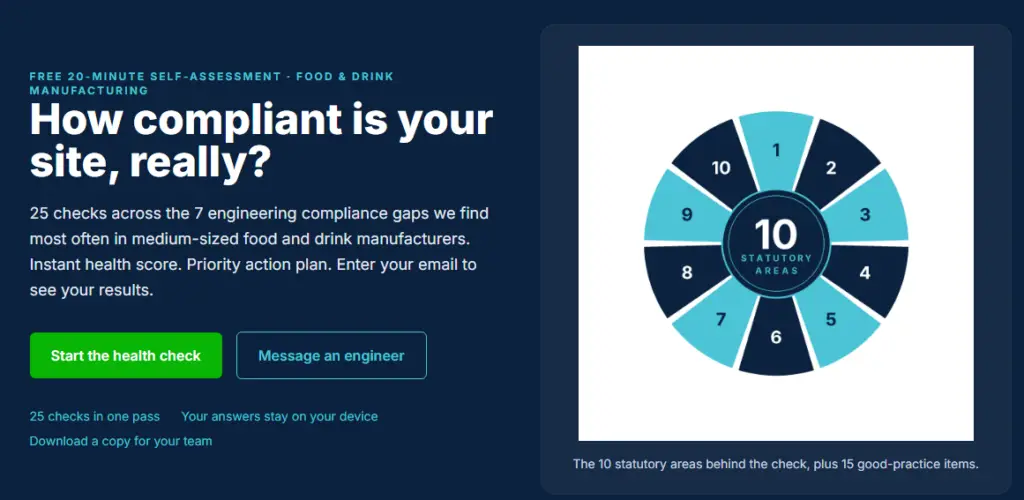
Download our free F&D Engineering Compliance Checklist – a 20-minute self-assessment that covers these 7 gaps and more. Use it to audit your own site before your next BRC review.
Try our Engineering Helpline — if you have an engineering question right now, WhatsApp us at wa.me/447926279853. You will talk to a qualified engineer, not a sales rep. No obligation, no forms, just answers.
Book a compliance assessment — if the checklist reveals gaps you need help with, we can arrange a full independent engineering compliance review of your site.
Ursa Engineering Solutions provides independent engineering advisory services to food and drink manufacturers across the North West and Yorkshire. Expert advisory. Full lifecycle. No fabrication bias. Find out more.